Planning guide
Just Engaged? The First 10 Things to Do (and What Can Wait)
What to do after getting engaged, in order: the first week, the three numbers to agree on, what to book first, and how long everything else can wait.
By Dominik, founder of BrideSpark · 15 min read

In the first week after getting engaged, tell the people who should hear it from you before anyone posts, check the ring fits and insure it, and agree on one answer to "so, when's the wedding?". In the first month, settle the most you'll spend, roughly how many guests, and a season. Then book the venue and the date together. The rest can wait, and this guide says until when.
The first 10 things to do after getting engaged, in order
Here is the whole order in one list. "Relax" and "soak it in" aren't steps, so they aren't on it. Do them anyway.
- Tell family and your closest friends yourselves, then post (first 48 hours). Nobody should find out from a feed.
- Check the ring fits and insure it (week 1). The risk starts the day you wear it, and free resizing often has a deadline.
- Agree on one answer to "when's the wedding?" (week 1). You'll be asked daily.
- Set up one shared inbox and one shared checklist (weeks 1-2). Every quote and contract lands where you can both see it.
- Set the most you will spend (weeks 2-4). It decides everything after it.
- Count heads, roughly (weeks 2-4). The cost and the size of the room both follow the guest count.
- Pick a season and a year, not a date (weeks 2-4). A fixed date rules out every venue that's taken that day.
- Shortlist venues, then book the venue and the date together (months 2-3). It's your first real commitment, and every other vendor quotes against it.
- Look up the legal paperwork window, and insure the wedding where that's sold (the week you pay the first deposit). From here on there's a deadline to know and money to lose.
- Book the people who can't double-book (months 2-4). A photographer shoots one wedding a day; most officiants, bands and DJs one or two.
Steps 5 to 7 are one conversation. If your wedding is less than nine months away, the order stays the same and the months shrink to weeks. There's a section on that further down.
How soon should you start planning? Plan early, commit late
As soon as you feel like it. Most advice for the newly engaged says to slow down, and that's half right. Nothing bad comes from reading venue price lists in week two or keeping a folder of dresses you like. The regrets couples describe on wedding forums are mostly about committing too soon: bridesmaids asked in the first week, invitations promised out loud at the engagement dinner, a date announced before the relatives who have to fly in were asked, a deposit on the first venue that fit the budget, a dress bought before there was a venue.
So before any decision in the first three months, ask one question: could we undo this next month, for free, without hurting anyone? Looking at venues and prices passes that test. Asking a bridesmaid or paying a deposit doesn't.
| Hard to undo | Safe once |
|---|---|
| Paying a venue deposit | You've agreed the three numbers below and compared at least three venues |
| Announcing a date | The venue contract is signed |
| Telling people they're invited | The headcount fits the venue and the budget |
| Asking your wedding party | The date is booked, and you've slept on it |
| Buying the dress | You know the venue and the season |
Week one: the news, the ring and one sentence
Tell people in the right order
Children first, if either of you has them. Then parents, then siblings, grandparents and your closest friends, in person or on a call, from the two of you. That's the Emily Post Institute's order (Emily Post). Divorced parents get a call each.
Two practical points. When you tell family, ask them not to post until you have. It only takes one proud parent with the proposal video. And agree with each other when your own post goes up: a day or two of private calls first is normal.
Check the ring fits, then insure it
If the ring spins on your finger or needs soap to come off, go back to the jeweler this week. Free resizing often has a deadline: at one large online jeweler we checked, it's 60 days for any size change and up to a year for a small one. Some rings can't be resized at all, including full eternity bands and metals like titanium.

Then insurance. Ask the person who bought the ring whether it's already insured, and in whose name. If it isn't, these are the facts for the US (checked November 2026):
- A standard homeowners policy covers stolen jewelry only up to about $1,500, according to the Insurance Information Institute. An accidental loss, like a ring down the kitchen drain, isn't covered by the standard policy.
- To cover it properly you either add the ring to your homeowners or renters policy as a listed ("scheduled") item, or buy a separate jewelry policy.
- A separate policy costs about 1-2% of the ring's value per year at Jewelers Mutual, a US jewelry insurer: roughly $60 to $100 a year for a $5,000 ring (Jewelers Mutual).
- You'll need the receipt or an appraisal. Keep a photo of both.
Outside the US the mechanics differ but the check is the same: look up the single-item limit on your home contents insurance. An engagement ring is often over it and has to be listed separately.
Agree on one answer to "when's the wedding?"
The question arrives with the first hug and doesn't stop. It's meant kindly, and it still feels like a deadline. Don't answer with a date you haven't booked.
Once you've settled on a season (that's step 7), add it to the first answer: "probably spring 2028".
One shared inbox, one shared list
Open a new email address you can both read, and use it for every venue inquiry, quote and contract. Your own inboxes stay yours, and nothing important lives in one person's phone.
Then decide who makes which calls. In Zola's 2026 survey of more than 11,500 couples, only 13% of opposite-sex couples said they split the planning equally (Zola). A shared list won't fix that, but it shows who is doing what. Any shared document will do. Ours is free and works before you have a date: leave the date empty and BrideSpark's wedding checklist still shows the first tasks in order, then fills in the due dates once you add one. Your partner joins with a link.
The three numbers to agree on before you contact a venue
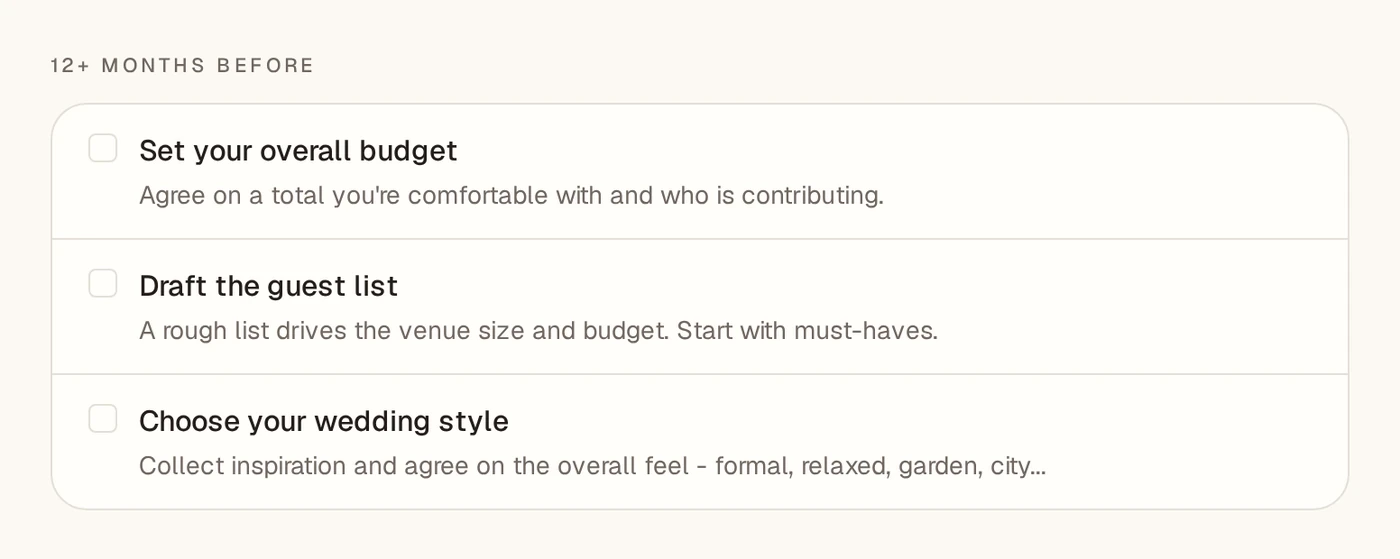
You can't settle the budget, the guest list or the date one at a time, so settle all three in one sitting. A venue's first two questions will be "how many?" and "when?". Sit down once, with no relatives in the room, and leave with a spending ceiling, a headcount range and a season. If you haven't agreed where (your town, theirs, abroad), settle that first.
The most you will spend
You don't need national averages for this. Add up three things: what you've already saved, what you can save each month multiplied by the months until the wedding, and what family has firmly offered.
Say you have 6,000 saved, can put away 900 a month and want to marry in about 16 months. That's 6,000 + (900 × 16) = 20,400. A parent offers 5,000, which makes 25,400. Hold back 10% for the charges nobody quotes up front, and you're planning a wedding of about 23,000.

Call it a ceiling, because first budgets tend to be hopes. In The Knot's 2026 Real Weddings Study, about half of US couples said their first budget was lower than what a wedding really costs, and 41% went over (The Knot). In the UK, Hitched found that 56% of couples married in 2025 overspent (Hitched).
Family money needs its own conversation, early. In the same Zola survey, 71% of weddings got some financial help. Ask for two things: a figure, and what's expected in return. Money often arrives with a vote on the guest list, and it's better to hear the conditions before you've spent any of it. If the conditions don't suit you, take less, or none.
Roughly how many people
Each of you writes the names you can't imagine the day without. Merge the lists, add the people you'd like to have, and you get a range: "80 to 100" is precise enough.
Now check the range against the ceiling. The Knot's 2026 study put the average US wedding in 2025 at $34,000, with 117 guests and $292 per guest (The Knot Worldwide). Hitched's UK figure is £272 per guest. Your prices will differ, but the arithmetic won't: 23,000 at 250 a head is 92 people. If your list says 140, either the list or the ceiling has to move, and it costs nothing to find that out now. Once you have a local quote, check it the same way: the venue's price per head times your headcount should come to about half your ceiling, no more.
Our wedding budget calculator does the per-guest sum as you change the headcount, and the guide to making a guest list has a tier method for the cutting. Until the venue is booked and the numbers fit it, don't invite anyone out loud.
A season and a year
Choose "spring 2028", not "May 13". A date chosen first rules out every venue that's taken that day. A season lets the venue's calendar pick the date for you.
Popular dates usually cost more and book up sooner. Roughly half of weddings fall on a Saturday: 47% in the UK and 53% in Australia, according to the 2026 reports from Bridebook and Easy Weddings. Fridays, Sundays and off-season months are often cheaper, so ask each venue for its prices by month and by day of the week.
Before you fix anything, ask the handful of people you won't marry without whether any dates are impossible for them: exams, a due date, a long-haul flight they can't afford in peak season.
Then write the result as one line: about 90 people, spring 2028, no more than 23,000. That line is your brief for every venue inquiry.
What to book first after getting engaged
The venue and the date, as one decision. The venue fixes the date, caps the headcount and takes the biggest share of the money: venue hire and catering came to 51% of the average UK couple's spend in Bridebook's 2026 report. It's also the booking that runs out first. Easy Weddings measured it: Australian couples booked the venue 11 months before the wedding on average, and the photographer, celebrant and musicians 9 months before. Peak-season Saturdays tend to go earlier still.
Shortlist three to five venues that fit your one-line brief. BrideSpark's vendor search can look for venues near your home or any town you type in, so it works before you have a venue to search around. Ask each one for an all-in quote for your headcount in your season: hire, food, drink, service charge, tax and any minimum spend. Before you sign, read the contract for what's included, the curfew, restrictions on outside vendors and the cancellation terms.
Couples on wedding forums say the same thing about this stage: everything feels stuck until the venue is booked, and easier afterwards. Once the contract is signed, the date is safe to announce. If one photographer or officiant matters more to you than the date, check they're free before you sign.
The week you pay the first deposit
Two small jobs belong to that week.
Look up the paperwork window. Don't file anything yet. Marriage paperwork can't be done too early or too late. A New York marriage license is valid for 60 days; in California and Texas it's 90, and in Ontario three months. In England and Wales you give notice at least 29 days before the ceremony and must marry within 12 months of giving it (GOV.UK). Ireland asks for three months' notice. Our city guides walk through the steps for Toronto, New York City, London and Dublin.
Insure the wedding, where that's sold. In the US, event insurance covers lost deposits if you have to cancel or postpone for a covered reason, and vendors who don't show up. Travelers sells policies from $160 and says the best time to buy is when you start paying deposits (Travelers, checked November 2026). A change of heart isn't covered. Elsewhere, ask an insurer what's available locally.
Then the people who can't double-book
A florist can supply several weddings in a day. A photographer shoots one. Book the people with one or two slots per date next: photographer, officiant or celebrant, band or DJ. If you want a planner, hire one before the rest, since choosing the others is half the job.
What can wait, and until when
Each row says how long it can be ignored.
| What | Leave it until | Why waiting is safe |
|---|---|---|
| Asking your wedding party | After the date is booked. 8-12 months before is plenty | Friendships and budgets shift over a long engagement |
| Engagement party | Optional. Before the venue is booked, invite only people who'd be at the wedding at any size | Everyone at the party will expect a wedding invitation |
| The dress | 9-12 months before | It should suit a venue and a season you've booked |
| Wedding website | Once the venue and date are booked | It has nothing to say before that |
| Save-the-dates | 6-8 months before, 8-12 for a destination wedding | Any earlier and the card is in a drawer when the invitation arrives |
| Engagement photos | Before the save-the-dates, if you want to use them | Otherwise whenever the light is good |
| Florist, cake, hair and makeup | 4-9 months before | They depend on the venue, the season and the headcount |
| Gift registry | 6-9 months before | Guests look for it when the save-the-date arrives |
| Honeymoon | Daydream now, book once the date is fixed | You can't book flights around a date you don't have |
| Invitations | 6-8 weeks before in the US, at least 12 weeks in the UK | Guests already have the date from the save-the-date |
| Changing your name | After the wedding | The marriage certificate is the proof offices ask for |
| Colors, hashtag, favors, first-dance song | Whenever it's fun | Nothing else depends on them |
The invitation timings are Emily Post's (and Debrett's for the UK); the dress window is what Kleinfeld Bridal tells its own customers (Kleinfeld). Our reasoning for the save-the-date window, with wording to copy, is in the save-the-date guide.
Trying on dresses for fun is fine in month one. Paying for one before you know the venue is the regret.
If your wedding is less than nine months away
A short engagement is perfectly workable. The order above holds. Some of the "can wait" rows stop waiting:
- Venue: this month. Ask about Fridays, Sundays and off-season dates, and favor venues with in-house catering, which saves you finding a caterer.
- Photographer: the week after the venue. Photographers shoot one wedding a day, so their calendars fill first.
- Dress: start now. Ordering and alterations can take around six months (the Better Business Bureau's planning figure), so ask about rush fees, off-the-rack dresses and sample sales.
- Save-the-dates: maybe never. Under four months out, skip them and send the invitations early.
- Paperwork: check it today. A three-month notice period, as in Ireland, can take a third of the time you have.
Other situations that change the order
| If this is you | Move this to the front |
|---|---|
| Parents are contributing | Get the figure and the conditions before you contact a single venue |
| The wedding is two or more years away | Do steps 1 to 7 now, then ask your shortlisted venues how far ahead they take bookings |
| Many guests will fly in, or it's a destination wedding | Ask the people you can't marry without about impossible dates, then send save-the-dates 8-12 months ahead |
| You want fewer than about 30 guests | Ask venues about minimum numbers and minimum spend before you visit |
| You're marrying in a country where neither of you lives | The paperwork: many countries ask couples who don't live there for extra documents or a period of residence |
| One of you dreads planning | Split by task: one of you takes money and contracts, the other takes guests and family |
Frequently asked questions
What is the first thing to do after getting engaged?
Tell your family and closest friends yourselves, before anything goes on social media. In the same week, check that the ring fits and get it insured. Planning can wait a few days: the first real planning task is agreeing a spending ceiling, a rough guest count and a season.
How soon should you start planning a wedding after getting engaged?
As soon as you feel like it. Looking at venues and prices early does no harm. What couples regret is committing early: paying a deposit, announcing a date or asking the wedding party before the budget, the headcount and the season are agreed. If the wedding is under nine months away, start on the venue this month.
What should you not do right after getting engaged?
Don't post before you've told family. Don't answer "when's the wedding?" with a date you haven't booked, and don't tell anyone they're invited. Hold off on asking your wedding party and buying the dress until the venue is booked, and don't pay any deposit until you've agreed a budget, a rough guest count and a season.
How long should you be engaged before getting married?
There's no right length. In The Knot's 2026 Real Weddings Study the average US engagement was 14 months; Zola's 2026 survey of its own couples found 18. In the UK and Australia the average is about two years, according to Bridebook's and Easy Weddings' 2026 reports. Nine to twelve months is enough time to plan most weddings.
Do you need to insure an engagement ring right away?
Yes, in the first week. In the US a standard homeowners policy typically covers stolen jewelry only up to about $1,500, and it doesn't cover a ring that's simply lost. A separate jewelry policy costs roughly 1-2% of the ring's value per year. You'll need the receipt or an appraisal.
When should you ask your bridesmaids and groomsmen?
After the venue and date are booked. There's no etiquette rule that it has to happen in the first weeks, and asking too early is a regret that comes up often on wedding forums, because friendships and finances change over a long engagement. Eight to twelve months before the wedding is plenty.
How do you announce your engagement?
In person or by phone first: any children either of you has, then parents, siblings and close friends. After that, everyone else. Ask family not to post until you have, and agree with your partner when your own post goes up. You don't have to announce it on social media at all.
Should you have an engagement party?
Only if you want one. The custom is to hold it one to three months after the proposal. Everyone invited to the engagement party should also be invited to the wedding, so keep it small until you know your guest count.
Plan it all in one place - free
Checklist, budget, guest list with online RSVPs, seating chart, timeline and your wedding website. Every feature, free for every couple.
Keep planning
All articlesPlanning guide
Wedding QR Codes: What to Link, How Big to Print, What to Say
Wedding QR codes for your RSVP, website and guest photos: what each should open, how big to print it, wording to copy, and the free generator trap to avoid.
Planning guide
Bilingual Wedding Website and Invitations: Setup and Wording
Set up a bilingual wedding website and invitations: what needs both languages, which tools handle accents, and copy-ready Spanish, French and Italian wording.
Planning guide
How to Collect Addresses for Wedding Invitations (10 Messages)
How to collect addresses for wedding invitations: when to start, what to ask each household, 10 messages to copy, and rules for kids, APO and overseas guests.