Planning guide
Bilingual Wedding Website and Invitations: Setup and Wording
Set up a bilingual wedding website and invitations: what needs both languages, which tools handle accents, and copy-ready Spanish, French and Italian wording.
By the BrideSpark team · 18 min read
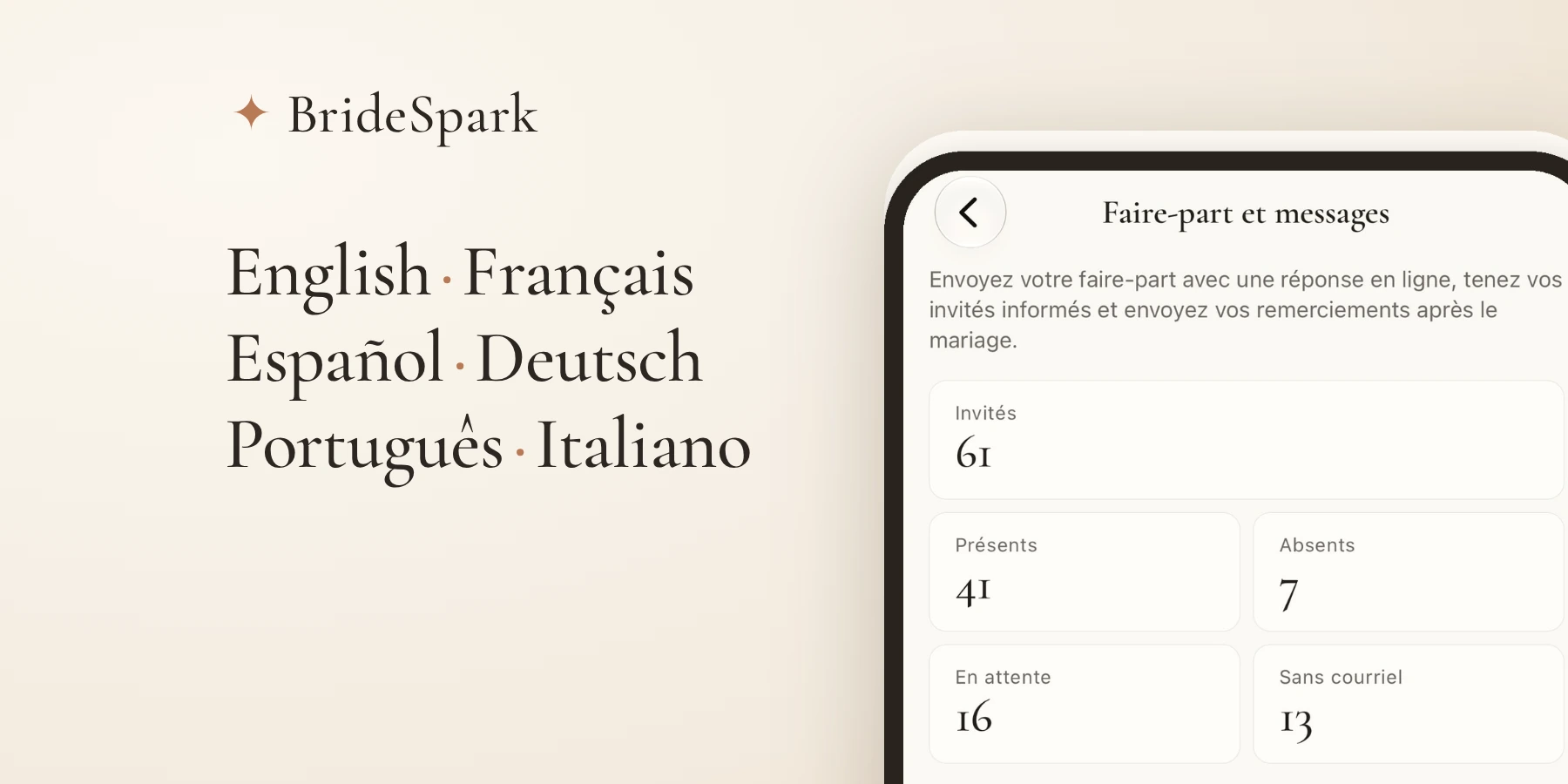
Put everything guests read in both languages: the invitation, RSVP, website, program and signs. For the website, that means one site with both languages on every page, not two sites. Keep what guests hear mostly in one language, with short summaries in the other, or the ceremony runs twice as long. Mark each household's language on your guest list, so every envelope and email matches the people opening it.
In a Spanish-English family, the second language is mostly for your oldest guests. In US Census data for 2018-2022, 79.8% of Spanish speakers aged 5 to 17 spoke English "very well." Among Spanish speakers 65 and over, only 41.6% did (US Census Bureau). Picture the grandmother who reads the invitation twice, keeps it on the fridge until June and would rather call your mom than open an RSVP link. Plan for her. The bilingual cousins will cope with whatever you choose.
Who needs the second language, and how much
Count households, not guests. Give every household on your list one tag: the main language, the second language, or "both" for anyone comfortable either way. A spreadsheet column does it, or a word in each guest's notes. That tag later decides which invitation a household gets, which language its emails are in, where it sits and whether it needs a printed program.
Then count the households that need the second language, because they're the ones that change the plan. Our rule of thumb:
| Households that need the second language | What we'd do |
|---|---|
| A handful (fewer than 1 in 10) | Keep everything in the main language. Give those households a translated invitation, a phone call instead of an online RSVP, and a seat next to someone who can translate. |
| A real minority (roughly 1 in 5 to 1 in 3) | Bilingual on paper: invitation, RSVP, program, signs, menu. Both languages on the website. Ceremony in the main language, with the key moments in both. |
| About half, or one whole side of the family | Equal weight everywhere. One officiant at ease in both languages, or two. Speeches alternate. |
The main language is the one most of your guests share, which isn't always the one you two speak at home. In Quebec, plenty of guests are "both": 46.4% of Quebecers can hold a conversation in English and French, according to Statistics Canada's 2021 Census. With a room like that, short summaries usually do the job of a full translation.
What needs both languages, piece by piece
The logic behind this table: a translated line on paper costs nobody any time, but every line repeated out loud is a minute the whole room sits through.
| Piece | Both languages? | How much | Our notes |
|---|---|---|---|
| Save the date | Optional | Date, place, "invitation to follow" | Short enough to do in both. Some couples keep it in one language and spend the effort on the invitation. |
| Invitation | Yes | All of it | Or a separate version only for the households that need it |
| RSVP card or form | Yes | Every question, every option, the deadline | A misread meal choice ends up on a plate |
| Website | Yes | Schedule, travel, hotels, RSVP, FAQ | Your story can stay in one language with a two-line summary |
| Ceremony | Partly | Main language, key moments in both | See the minute budget below |
| Program | Yes | Readings and vows in full | The full translation lives here, so the ceremony doesn't have to carry it |
| Signs and menus | Yes | A few words each | The cheapest translation you'll do |
| Speeches | Speaker's choice | A one-line summary in the other language | Ten minutes each, at most |
| Emails and updates | Per household | Their language, or both | This is where the tag earns its keep |
| Thank-you notes | Per household | The guest's language | If you don't write it, three lines checked by a relative beat a page they can't read |
How to set up a wedding website in two languages
You have three options: one site with both languages on every page, one site with a language switch, or two separate sites. The first suits most weddings. We'd skip the third, which means two sets of replies to merge and every change, like a new hotel block, made twice. The sections themselves are the same as on any wedding site, and our guide to what to put on a wedding website walks through them.
One site, both languages on every page
Write each section in the main language, then the second language straight underneath, in the same order every time so readers learn where to look. Title every section in both languages, and cut harder than you would on a one-language site, because two paragraphs have just become four. Titles you can copy:
| English | Español | Français | Italiano |
|---|---|---|---|
| Schedule | Programa | Programme | Programma |
| Getting there | Cómo llegar | Comment s'y rendre | Come arrivare |
| Where to stay | Dónde hospedarse | Hébergement | Dove dormire |
| Registry | Mesa de regalos (Mexico), lista de bodas (Spain) | Liste de mariage (France), registre de cadeaux (Quebec) | Lista nozze |
| Questions | Preguntas frecuentes | Questions fréquentes | Domande frequenti |
| RSVP | Confirmar asistencia | RSVP | Conferma la presenza |
One site with a language switch
Some builders let guests flip the site's built-in buttons into their language and show each guest the pages written for them. The catch is upkeep. On Joy, which is free, you make a copy of each page per language and show it to guests by tag, and Joy's help page warns that "any guest without a tag or not selected individually won't see that page." Its "Duplicate and Translate" option translates a page once and the copy doesn't update, so if you change the shuttle time on the English travel page, the Spanish copy keeps the old one. WedSites puts a language selector in the menu and can open each guest's RSVP link in their language, but only on its $199 Pro plan, and you still write and update every version yourself.
The RSVP, in both languages
Wherever the RSVP lives, put every question and every option in both languages, and repeat the deadline in both. On the paper invitation, print a phone number or email next to the website address for households that won't go online. For the households tagged second-language only, plan on a phone call a week before the deadline, from the relative they'd most like to hear from.
What the main tools do with two languages
| Tool | Built-in wording (buttons, forms) | Your own text | Cost |
|---|---|---|---|
| BrideSpark | One language for all guests, chosen from 7. Buttons, the RSVP form, the fixed parts of guest emails and date formats follow it. Guests can't switch. | Both languages in the same field, for example "Getting there · Cómo llegar". No automatic translation. | Free |
| Joy | Guests tap a globe icon to switch Joy's menus and buttons (Joy supports "a limited set of languages" for this) | A copy of each page per language, shown by guest tag, and RSVP questions per language. "Duplicate and Translate" copies don't update, and Registry, RSVP and Schedule pages can't be duplicated. | Free; Joy lists no extra charge for languages |
| WedSites | Guests get a language selector in the site menu; you can give each guest a language, and their RSVP link opens in it | You write each language version yourself | Pro plan: $199 one-time (US price), with 24 months of hosting |
| Riley & Grey | One "Website Language" for buttons, headers and the RSVP page, in English or one of 13 other languages. Guests can't pick: "we don't currently offer an option" for that. | Stays as you wrote it. Its help center suggests both languages on one site, or a cloned second site, 50% off on request. | Free to design; $39 a month or $299 a year to publish |
| Zola | Clickable buttons "would remain in English" | You can add your own sections in a second language (but see accents, below) | Free |
| The Knot | Some text, such as the RSVP page, can't be changed | You can retype most titles and text, "except for special characters" | Free |
Test accents before you build anything. Zola's help center says it is "not able to support special characters" on wedding websites, and The Knot's lets you change text "except for special characters". Neither page says which characters it means, so type ñ, é and à into a test page and check it on your phone.
On a BrideSpark wedding website, set "Guests' language" in your wedding settings to your main language: English, French, Canadian French, Spanish, German, Brazilian Portuguese or Italian. Then write your own text in both languages, down to meal options like "Fish · Pescado". If a language switch for guests matters to you, BrideSpark doesn't have one; Joy and WedSites (on its Pro plan) do.
Bilingual invitation layouts that don't look crowded
Pick the layout by how many households need the second language, which your tags already tell you.
| Layout | Works best when | Watch out for |
|---|---|---|
| Side by side, one column per language | Both languages carry equal weight | Needs a wide card. Spanish and French lines tend to run longer than English, so size the type for the longer column. |
| Stacked, main language on top | One language clearly leads | Leave real space between the two blocks, or it reads as one long text |
| One language per side, front and back | You want an uncluttered front | Some guests never turn a card over, so put the RSVP date on both sides |
| Main card plus a translated insert | Only a few households need the second language | Inserts get lost. Repeat the RSVP details on the insert. |
| Separate versions per household | A handful of households, or two families with almost no shared language | Two print runs, and every envelope has to match its tag |
Space is the real limit. Paperlust's guide to Mexican invitations suggests 60 to 90 words per language on a 5x7 card, so we'd keep a bilingual card to who, when and where, and send hotels, dress code and registry to the website.
Whatever the layout, keep each language in its own block, so a reader can follow one language top to bottom without hopping. Don't translate people's names, the venue's name or the street address, but do give the city its own name in each language: Florence and Firenze, Montreal and Montréal. Lead with the main language, or with the hosts'. Spanish traditionally comes first on Mexican invitations, and Paperlust says reversing the order is fine if your guest list leans the other way.
Count your tags before you order. Say you have 74 households: 60 tagged English or both, 14 Spanish only. That's close to one in five, so one bilingual run of 74 cards (plus spares) is simpler than two runs and an afternoon matching envelopes to tags. With only five Spanish-only households, separate versions win. BrideSpark's free printable invitations let you edit every line of a design, so you can download the English PDF, retype the lines in Spanish and download the second version.
Bilingual wedding invitation wording you can copy
Every example below is for the same made-up wedding: Saturday, June 12, 2027, at 4 pm, with replies due by May 1. In the tables, each row is one printed line. Change the names, then have someone who grew up speaking the other language read it aloud before it goes to print, because you won't see typos in a language you don't read. Our wedding invitation wording guide has more English versions.
English and Spanish
Save the date, one block per language (more English versions in our save the date wording guide):
The invitation, hosted by the couple:
| English | Español |
|---|---|
| Together with their families | Junto con sus familias |
| Ana Lucía Morales Ríos and James Carter | Ana Lucía Morales Ríos y James Carter |
| request the pleasure of your company | tienen el gusto de invitarlos |
| at the celebration of their marriage | a celebrar su boda |
| Saturday, June 12, 2027 | el sábado 12 de junio de 2027 |
| at four o'clock in the afternoon | a las cuatro de la tarde |
| [Venue], San Antonio, Texas | [Venue], San Antonio, Texas |
| Reception to follow | Recepción a continuación |
Invitarlos works across Latin America and the US. In Spain, where friends are vosotros, a couple would more often write invitaros.
The formal version, with both sets of parents as hosts, in the traditional Mexican church style:
Its English partner is the classic "request the honor of your presence at the marriage of their children," in its own block. Look closely at año. Without the tilde it becomes ano, which means anus, and one wording guide that ranks for bilingual invitation searches prints "del ano dos mil veintiseis" in its sample text (veintiséis lost its accent too). Sábado, invitación, Ríos and Lucía all need theirs.
The smaller lines:
| English | Español |
|---|---|
| Kindly reply by May 1 | Favor de confirmar su asistencia antes del 1 de mayo (Mexico); Se ruega confirmar asistencia antes del 1 de mayo (Spain) |
| We have reserved 2 seats in your honor | Pase para 2 personas |
| Adults-only celebration | Celebración solo para adultos |
| Dress code: cocktail attire | Código de vestimenta: cóctel |
| We gratefully recognize our padrinos and madrinas | Agradecemos a nuestros padrinos |
Pase para 2 personas is a Mexican convention rather than a translation: a line, or a little card, saying how many people the invitation covers, so nobody has to write "no plus-ones." On Mexican invitations, padrinos are listed by role (lazo, arras, flores, pastel), and the English line tells everyone else who they are.
English and French
In France, the heading is often left in English as "Save the date," and that's fine there too.
The invitation, in Quebec usage:
| English | Français |
|---|---|
| Together with their families | Entourés de leurs familles |
| Camille Gagnon and Daniel Price | Camille Gagnon et Daniel Price |
| request the pleasure of your company | ont la joie de vous inviter |
| at the celebration of their marriage | à leur mariage |
| Saturday, June 12, 2027 | le samedi 12 juin 2027 |
| at four o'clock in the afternoon | à 16 h |
| [Venue], Montreal | [Venue], Montréal |
| Cocktails and dinner to follow | La cérémonie sera suivie d'un cocktail et d'un souper |
Two brides make it Entourées. For a wedding in France, the last line becomes "La cérémonie sera suivie d'un vin d'honneur et d'un dîner." The meal word changes because dîner is the evening meal in France but lunch in everyday Quebec French. The dictionary of Quebec's French-language office, the OQLF, gives souper for the evening meal and keeps dîner in that sense mostly for protocol-style events. A Montreal family will understand dîner, but souper is the word they'd have written. If the wedding is in Quebec, our Montreal wedding guide covers the legal side, including whether the ceremony is in French or English.
The traditional version, with the parents as hosts:
On an invitation, the OQLF capitalizes the guest's Madame or Monsieur but writes the hosts' in lowercase, so here only the first word, which starts the sentence, gets a capital. In France, a faire-part can also come in tiers, with the ceremony, the vin d'honneur and the dinner each going to a smaller circle of guests. If you use tiers, spell them out on the English side, where guests won't know the convention.
| English | Français |
|---|---|
| Kindly reply by May 1 at 514-555-0123 or on our website | RSVP avant le 1er mai au 514 555-0123 ou sur notre site web |
| Regrets only | RSVP en cas d'empêchement |
| Black tie | Smoking |
| This is an adults-only celebration | Cette célébration est réservée aux adultes |
English and Italian
| English | Italiano |
|---|---|
| Giulia Ferraro and Ben Walsh | Giulia Ferraro e Ben Walsh |
| are delighted to announce their marriage | annunciano il loro matrimonio |
| Saturday, June 12, 2027, at four o'clock | sabato 12 giugno 2027, alle ore 16 |
| [Venue], Florence | [Venue], Firenze |
| Reception to follow at [Venue] | Dopo la cerimonia, gli sposi saranno lieti di salutare parenti e amici presso [Venue] |
| Kindly reply by May 1 | Si prega di confermare la presenza entro il 1° maggio |
The Italian partecipazione traditionally announces the wedding, and the reception invitation (the fifth line) often goes on its own small card. Keep that shape on the Italian side rather than forcing "request the pleasure of your company" into Italian. If most guests are flying in, our guide to planning a destination wedding covers the travel side.
Other language pairs
After Spanish, the most common languages spoken at home in the US are Chinese (5.1% of people who speak a language other than English at home) and Tagalog (2.5%), according to the same Census release. For those and any other pair, have a family member write the second side from scratch rather than translate your English, because invitation conventions differ more than the words do. If the language uses another script, type a line of it into your website builder and check it on a phone first.
The small mistakes that give a translation away
| Mistake | Write instead | Why |
|---|---|---|
| ano, sabado, invitacion | año, sábado, invitación | Missing accents change words in Spanish, and a native reader spots them first |
| 12 de Junio, 12 Juin, 12 Giugno | 12 de junio, 12 juin, 12 giugno | Spanish, French and Italian write months and weekdays in lowercase |
| 4:30 PM, or 16h30, on the French side | 16 h 30 | The OQLF prefers the 24-hour clock with a space on each side of the h, and rejects forms like 9h and 9:00 h |
| le 1 mai, il 1 maggio | le 1er mai, il 1° maggio | The first of the month takes an ordinal in French and Italian |
| R.S.V.P. in Quebec French | RSVP | The OQLF writes it without periods |
| RSVP regrets seulement | RSVP en cas d'empêchement | The OQLF calls "regrets seulement" a calque of the English |
| Tenue de soirée for "formal" | Smoking (black tie) or tenue de ville (dark suit and tie) | The OQLF defines tenue de soirée as white tie: tails and a white bow tie |
| Dîner for the evening meal in Quebec | Souper | In everyday Quebec French, dîner is lunch; the OQLF gives souper for the evening meal |
| 06/07/2027 | June 7, 2027 and le 7 juin 2027 | An American reads June 7; most of the world reads 6 July. Spell out the month. |
| A word-for-word "request the pleasure of your company" | The other language's own formula | Ont la joie de vous inviter and tienen el gusto de invitarlos are the usual formulas. Literal versions read as translated. |
A bilingual wedding ceremony that doesn't run twice as long
Don't translate every line. Say the spoken part of your ceremony takes 15 minutes in one language. Here's what each approach adds. These are our estimates for that made-up ceremony, not measurements:
| Approach | What guests hear | Adds roughly |
|---|---|---|
| Every line in both languages | Everything twice | 15 minutes |
| Main language, with summaries | The main language in full; a sentence or two of summary after each part; vows and the declaration in both | 4 to 6 minutes |
| Main language, translation in the program | A welcome in both languages, then the main language, with the full translation printed for guests to follow | About 1 minute |
We'd pick the middle row for most weddings. It works with any of these officiant setups:
- One officiant at ease in both languages, leading in the main one and summarizing in the other. This is Aisle Planner's first choice, and ours.
- Two officiants, one per language, taking turns.
- A translator sitting with the few guests who need one. For guests from many countries, Inside Weddings suggests a hired translator with wireless headsets.
Say your vows in your own language, or learn them in each other's. Either way, print both versions in the program so nobody has to guess what was promised. Keep readings short, one in each language. If the legal words have to be said or understood in a particular language where you marry, your officiant or registrar will know, so ask early whether an interpreter has to be there.
Speeches, signs and the seating plan
Let each speaker use the language they're most comfortable in, as WeddingWire and Aisle Planner both suggest, and hold everyone to Aisle Planner's "10 min tops." Alternate the languages so neither half of the room goes quiet for long. Ask each speaker to close with one sentence in the other language, even a clumsy one, or give the MC a one-line summary to read. Announcements from the MC or DJ ("dinner is served," "last dance") go in both.
Signs pay off fastest, because a guest can't ask where the restrooms are if nobody nearby speaks their language. Copy what you need:
| English | Español | Français | Italiano |
|---|---|---|---|
| Welcome to our wedding | Bienvenidos a nuestra boda | Bienvenue à notre mariage | Benvenuti al nostro matrimonio |
| Find your table | Encuentra tu mesa | Trouvez votre table | Trova il tuo tavolo |
| Unplugged ceremony: please put your phones away | Ceremonia sin celulares: por favor, guarda tu teléfono | Cérémonie déconnectée : merci de ranger vos téléphones | Cerimonia senza cellulari: per favore, metti via il telefono |
| Cards and gifts | Tarjetas y regalos | Cartes et cadeaux | Biglietti e regali |
| Share your photos: scan the code | Comparte tus fotos: escanea el código | Partagez vos photos : scannez le code | Condividi le tue foto: inquadra il codice |
| Restrooms | Baños | Toilettes | Bagni |
For guests from Spain, swap celulares for móviles.
At the tables, mix the families by all means, but follow Aisle Planner's rule of at least two people who share a language at every table. Your household tags make that quick. Put a bilingual cousin at each mixed table and tell them in advance that translating is their job for the evening. Our guide to making a seating chart covers the rest of the plan.
Frequently asked questions
Do we need two wedding websites for two languages?
No. One site with both languages on every page works for most weddings, as long as each section is short and titled in both languages. Joy (free) and WedSites (on its $199 Pro plan) also offer a language switch for guests, but you then keep a separate version of each page and update both by hand.
Which language goes first on a bilingual invitation?
The main language, meaning the one most guests share, or the language of the hosts. Spanish traditionally comes first on Mexican invitations, but if most of your guests read English, it's fine to flip the order. In a side-by-side layout, the first language goes on the left.
Should every guest get the bilingual invitation?
Not necessarily. If only a handful of households need the second language, print a separate version for them and keep everyone else's card uncluttered. Once roughly one household in five needs it, one bilingual invitation for everyone is easier to print and mail.
Do save the dates need to be bilingual?
They don't have to be. A save the date carries only the names, the date, the place and a line saying an invitation will follow, so one language works for most couples. Because it's so short, doing both costs very little, and relatives who read only the second language will notice.
How do you write the date and time on a bilingual invitation?
Spell out the month in each language, because 06/07/2027 means June 7 to an American and 6 July to most of the world. Spanish, French and Italian write months and weekdays in lowercase: 12 de junio, 12 juin, 12 giugno. On the French side, use the 24-hour clock with a space on each side of the h, as in 16 h or 16 h 30.
How do you keep a bilingual ceremony from running long?
Hold the ceremony in the main language and give the other one short summaries of each part, plus the vows and the declaration in both. Print the full translation in the program. Repeating every line roughly doubles the spoken part of the ceremony.
Can we use Google Translate for our wedding invitations?
Use it to understand a draft, not to write the final card. A machine translates your English formula instead of using the other language's own, and it has to guess the register (tú or usted, tu or vous). Have a native speaker write or check the second language and read it aloud before you print.
Plan it all in one place - free
Checklist, budget, guest list with online RSVPs, seating chart, timeline and your wedding website. Every feature, free for every couple.
Keep planning
All articlesPlanning guide
How to Collect Addresses for Wedding Invitations (10 Messages)
How to collect addresses for wedding invitations: when to start, what to ask each household, 10 messages to copy, and rules for kids, APO and overseas guests.
Planning guide
Wedding Day Timeline: 5 Sample Schedules, Minute by Minute
Wedding day timeline samples where the minutes add up: 4 pm with and without a first look, 6 pm, a 1 pm Mass, a micro wedding, and real 2027 sunset times.
Planning guide
How to Plan a Destination Wedding: Legal Rules by Country (2026)
How to plan a destination wedding: marry legally abroad or at home, rules for 11 destinations checked October 2026, a timeline, who pays and real costs.