Planning guide
How to Make a Wedding Seating Chart (Without the Drama)
How to make a wedding seating chart step by step: head table options, divorced parents, kids' tables, table sizes, escort cards vs a seating sign, and timing.
By the BrideSpark team · 10 min read
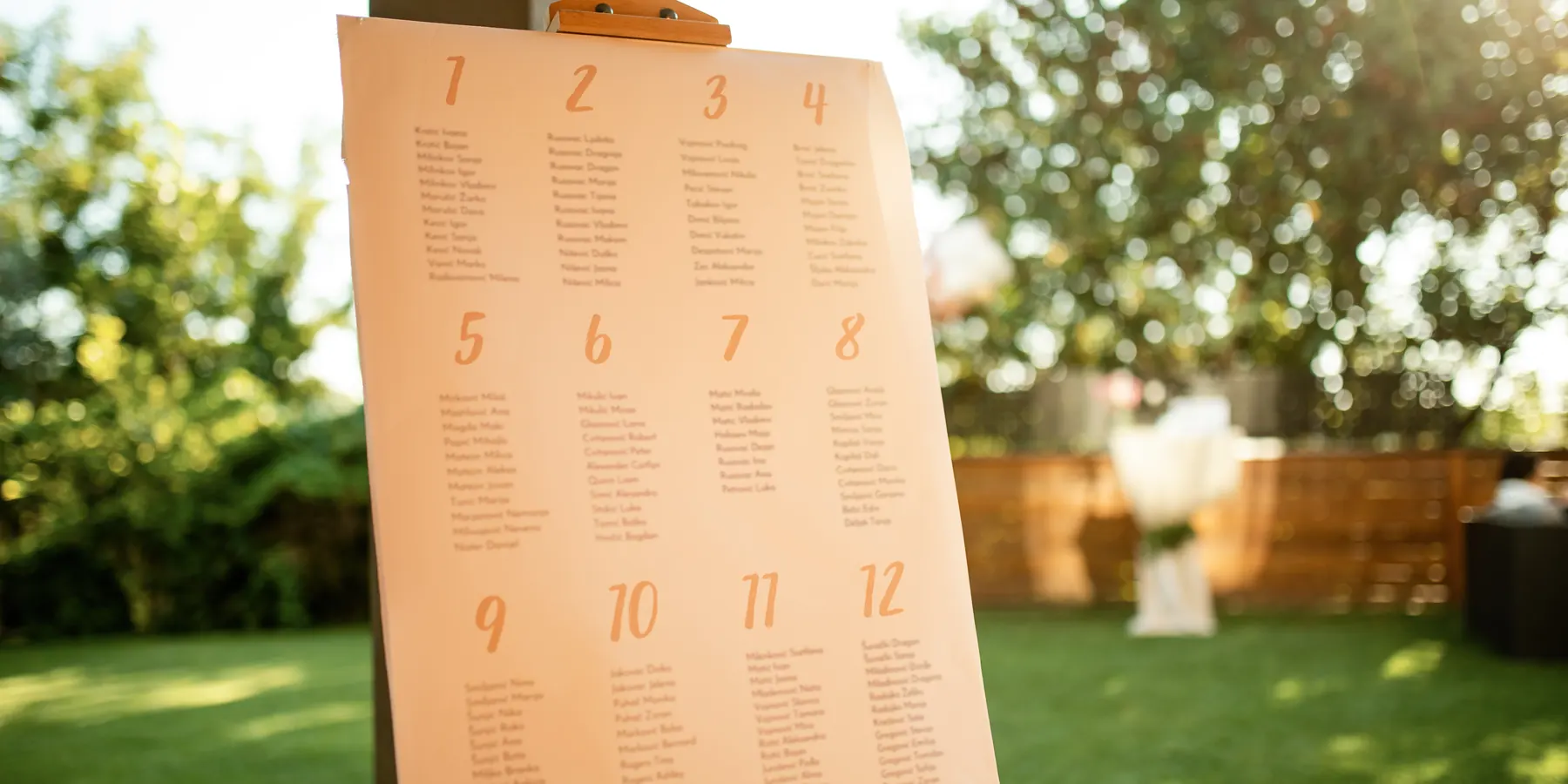
Wait until your RSVPs are in. Then decide where the two of you sit, place immediate family next, and build the rest of the room out of friend groups so every guest knows at least one person at their table. The stress almost never comes from the room as a whole; it comes from four or five relationships that need careful handling, so deal with those first and the other 90% of the chart goes surprisingly fast.
When to make your seating chart
Do the real work after your RSVP deadline, which for most couples falls two to four weeks before the wedding. Start earlier and you are seating people who may not come, and every "sorry, we can't make it" means pulling a table apart.
There is still useful groundwork you can do in advance:
- Ask the venue for a floor plan. You want the number and shape of tables, where the dance floor, bar, speakers and exits are, and how many chairs each table actually takes once it is set.
- Settle your head table format (more on that below). It decides how many seats are left for everyone else.
- Sketch your groups. Go through the guest list and cluster people: college friends, your partner's old team from work, each side's cousins, the neighbors. Those clusters are your future tables.
Aim to have it done about a week out. Caterers and venues usually want a final count and table list a few days ahead so they can set the room and match meal choices to seats. Your contract will have their exact deadline.
How to make a wedding seating chart, step by step
- Get the final list of who is coming. Only the yeses, including confirmed plus-ones and children.
- Set up your tables to match the venue plan: how many, what shape, how many seats each.
- Place the two of you at a head table, a sweetheart table or a regular table.
- Seat parents and grandparents near you and near the front.
- Place the wedding party and their partners.
- Build tables from friend groups, biggest groups first. They are the hardest to fit, and a group of nine will not squeeze into the last table of eight.
- Fill the gaps with floaters, the guests who do not belong to a big group. Put them with people they share something with: the same hometown, the same job, kids the same age.
- Check the problem pairs (exes, relatives who are not speaking) and make sure they are not at the same table or the one next to it.
- Leave one or two seats open for the inevitable last-minute change.
- Show the draft to both families, take their notes, then lock it.
Paper and sticky notes are fine for a small wedding. Past about 60 guests, you will spend more time erasing than seating. In BrideSpark's seating chart, everyone who has RSVPed yes waits in a "To seat" list, a household moves to a table in one go, and each table shows how many seats are still free.
Head table options
There is no correct answer here, only the one that suits your family and the feel of the room.
| Option | Who sits there | Good for |
|---|---|---|
| Traditional head table | You, plus the wedding party, usually in a long row facing the room | Large wedding parties, formal receptions |
| Head table with partners | Same, but wedding party partners join instead of sitting elsewhere | Couples whose friends are all in long-term relationships |
| Sweetheart table | Just the two of you | Avoiding hard choices, complicated families, a quiet moment together |
| Family table | You plus both sets of parents (and sometimes grandparents) | Close families, smaller weddings |
| Sitting with guests | You at a regular round table with your closest friends | Relaxed, informal weddings |
The long head table photographs beautifully, but it splits couples up. Your best man is at the front; his girlfriend, who knows nobody, is at table 9 making small talk with your great-aunt. Either give wedding party partners a seat at the head table or put them together at a table right beside it.

Where parents and family sit
Traditionally each set of parents hosts their own table near the front, joined by grandparents, siblings who are not in the wedding party, and the officiant and their partner if they are staying for the reception. Grandparents and older relatives want to be close to you but not next to the speakers, and within easy reach of the restrooms and an exit.
Divorced or separated parents
This is the question that keeps couples up at night. Some approaches that work:
- Two parent tables of equal standing. Each parent hosts their own table, the same distance from you, with their partner and their side of the family. Nobody looks demoted.
- Ask them. Plenty of divorced parents are perfectly happy to share a table for one evening. Some are not. A short, private "Would you rather have your own table?" beats months of guessing.
- Use a sweetheart table. If no parents sit with you, nobody has to be left off.
- Keep new partners with their partner. A parent's spouse or long-term partner sits beside them. Separating them to keep the peace tends to cause more trouble than it prevents.
If things are tense, put the two tables on opposite sides of the room, each with a clear view of you and not much of a view of each other.
Family dynamics in general
Seat people where they will be comfortable, not where the family tree says they belong. The cousin you see every week can sit with your friends. The uncle who overdoes it should not be next to the bar. Relatives who are feuding go at tables that are not side by side and not on the path to the dance floor.
You are not obliged to fix anyone's relationship with a seating chart. You are only trying to get everyone through a calm, happy evening.
The kids' table
A kids' table works when you have several children, roughly 5 to 12, who know each other or will happily get on. Make it worth sitting at: activity sheets, crayons, a sitter if the budget stretches, and a spot where parents can see it from their own tables.
Children under about 5 stay with their parents. Teenagers usually want to sit with the adults, or at a "cousins" table of their own. If only two or three children are coming, seat them with their families and skip the kids' table altogether.
Put families with small children near the doors. A tired three-year-old will need to leave the room at some point, and it is better for everyone if that does not involve crossing the dance floor.
Table shapes and how many guests fit
Capacity depends on chair width, place settings, centerpieces and whether you are serving a plated meal or a buffet, so confirm with your venue or rental company. As a working guide, this table rental guide from Hill Country Event Rentals lists:
| Table | Comfortable seating |
|---|---|
| 48" round (about 120 cm) | 4 to 6 |
| 60" round (about 150 cm) | 6 to 8 |
| 72" round (about 180 cm) | 8 to 10 |
| 6 ft banquet (rectangular) | 6 to 8 |
| 8 ft banquet (rectangular) | 8 to 10 |
Some venues will tell you a 60" round seats 10. For a buffet, maybe. For a plated dinner with a full set of glasses, elbows start to touch, so ask to see a table fully set before you agree to it.
Rounds are the classic for a reason: everyone can talk to everyone, and they suit friend groups of 8 to 10. Long banquet tables feel relaxed and fit more people into a narrow room, but guests mostly talk to whoever is next to and opposite them, so getting the groups right matters even more. The upside is flexibility. A long table can stretch to take a group of 13 without splitting it in half.
To work out how many tables you need, divide your confirmed guest count by seats per table and round up. For 112 guests at tables of 10, that is 12 tables, with 8 spare seats to absorb awkward group sizes.
Seating chart etiquette guests notice
- Everyone knows someone. Each guest should know at least one other person at their table. A pair of strangers placed between two friend groups is fine. One person alone at another group's reunion is not.
- Couples sit together. Married, engaged and long-term couples go side by side, or at the very least at the same table.
- Singles are not a project. We'd skip the singles table. It tends to feel like a spotlight, and the people at it know exactly why they are there. Mix single friends in with people they already know.
- Vendors who stay need seats too. Photographer, videographer and planner ideally get a small table near the action. Check your contracts, since many include a vendor meal.
- Do not seat by status. Guests notice when the "important" people are up front and everyone else is by the kitchen doors. Spread the good spots around.
How to show guests where to sit
You have three common options, and you can mix them.
Seating chart sign
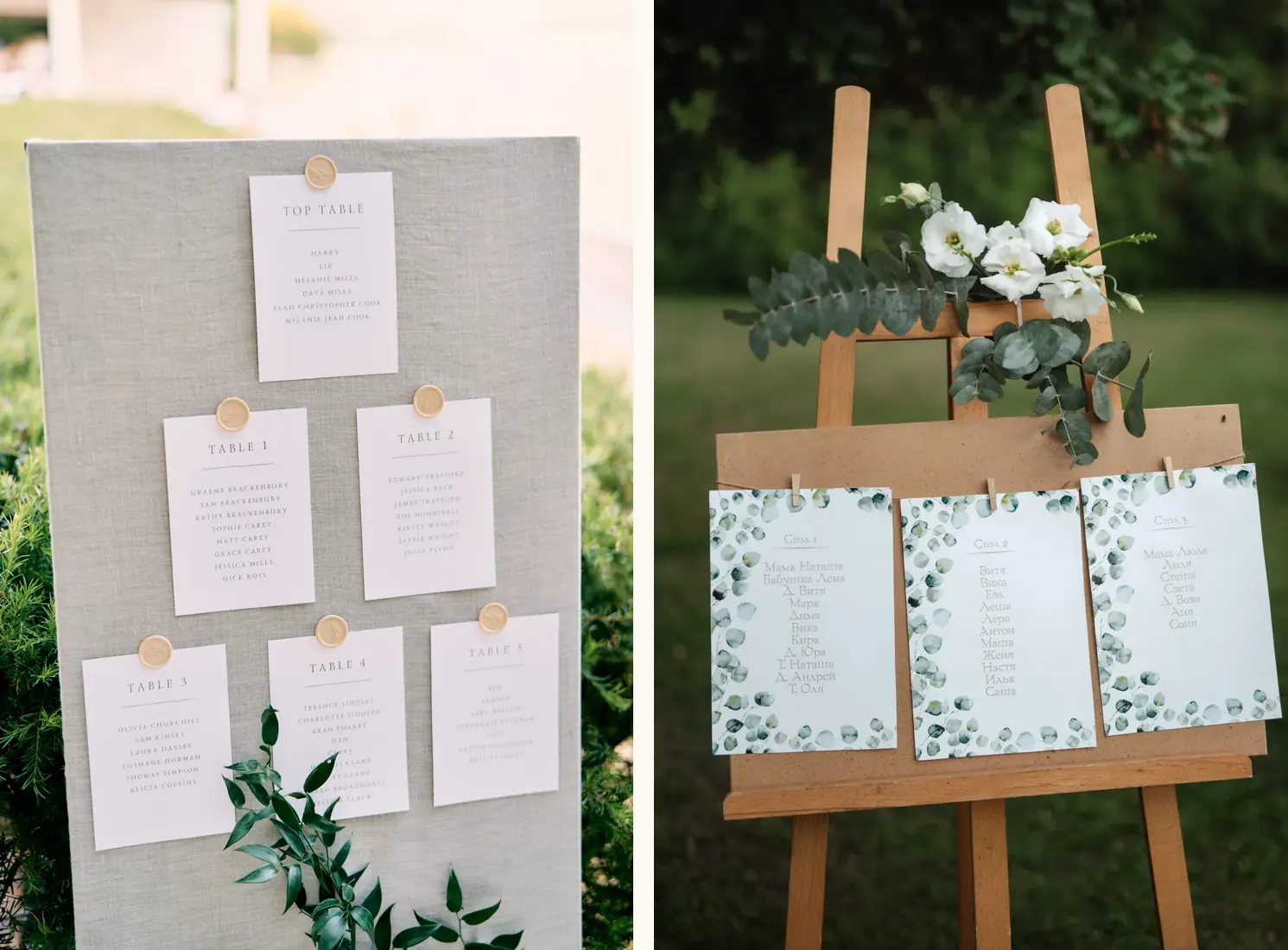
One large sign, usually near the entrance to the reception, listing either each table with its guests or every guest alphabetically with a table number. It is the cheapest option, you can change it until a day or two before, and it is one thing to set up rather than a hundred. Past about 120 guests, go alphabetical rather than by table. Nobody wants to scan twelve columns looking for their own name while the line behind them grows.
Escort cards
One small card per guest (or per couple), set out on a table near the entrance, each with a name and table number. Guests pick theirs up and carry it to their table. Escort cards look lovely and can double as the favors, but they take longer to make and lay out. At an outdoor venue, one gust of wind and you are rebuilding the display by hand.
Place cards
A card at each setting with the guest's name, marking their exact seat. You only need them if you are assigning seats, not just tables. That helps for plated meals (the servers know who ordered the fish) and for the head table. Many couples assign tables only and let guests pick their own chair.
The most common pairing is a seating chart sign plus place cards: the sign gets people to the right table, the cards settle them into a seat. If you plan with BrideSpark, the printable seating chart and place cards fill in from your seating plan, so moving someone from table 4 to table 7 the night before does not mean retyping anything. If you are working from a spreadsheet instead, you can paste a list into the free printable place cards and get one card per guest.
A quick checklist before you print
- Every guest who is coming has a table, and no table is over capacity.
- Names are spelled the way guests spell them. Check the RSVP replies, not your memory. It is Katharine, not Catherine.
- Meal choices and allergies are marked table by table for the caterer.
- The table numbers on the sign match the numbers the venue will put on the tables.
- Someone other than you (a planner, coordinator or trusted friend) has a copy on the day to handle surprises.
Frequently asked questions
When should I do my wedding seating chart?
After your RSVP deadline, usually two to four weeks before the wedding, so you are working from the final guest list. Finish about a week before so the venue and caterer have time to prepare.
Do I have to assign seats at a wedding?
No. You can assign tables only and let guests choose their seat. Exact seats with place cards are most useful for plated dinners and the head table. For a cocktail-style reception, open seating with a few reserved tables for family works fine.
Where do divorced parents sit at a wedding?
Most often at two tables of equal standing near the front, each parent hosting their own with their partner and relatives. If they get along, they can share a table. Ask them privately rather than guessing.
How many people fit at a wedding table?
As a rough guide, a 60-inch round seats 6 to 8, a 72-inch round seats 8 to 10, and an 8-foot banquet table takes 8 to 10. Confirm with your venue, because chair size and place settings change the numbers.
Should I have a kids' table?
It works when several children aged roughly 5 to 12 are coming and the table can sit within sight of their parents. Keep toddlers with their families, and let teenagers sit with the adults or at their own table.
What is the difference between escort cards and place cards?
Escort cards tell guests which table they are at and are collected near the entrance. Place cards sit on the table and show which seat is theirs. A seating chart sign can replace escort cards entirely.
Plan it all in one place - free
Checklist, budget, guest list with online RSVPs, seating chart, timeline and your wedding website. Every feature, free for every couple.
Keep planning
All articlesPlanning guide
Wedding Budget Breakdown: Percentages, Averages and an Example
A wedding budget breakdown by category with typical percentages, 2025-2026 average costs in the US, UK, Canada and Australia, hidden costs and payments.
Planning guide
How to Make a Wedding Guest List (and Cut It Without Guilt)
How to make a wedding guest list: a simple tiers method, plus-one and kids rules, A/B lists, households, collecting addresses and how to cut your list kindly.
Planning guide
Wedding RSVP Wording: Examples, Deadlines and Polite Reminders
Copy-ready wedding RSVP wording for formal, casual and online invitations, plus when RSVPs should be due, what to ask and how to chase late replies.