Planning guide
Wedding Invitation Wording: 30 Examples, Line by Line
Wedding invitation wording line by line: 30 copy-ready examples for divorced, late and paying parents, the rules guides disagree on, and a proof checklist.
By the BrideSpark team · 20 min read
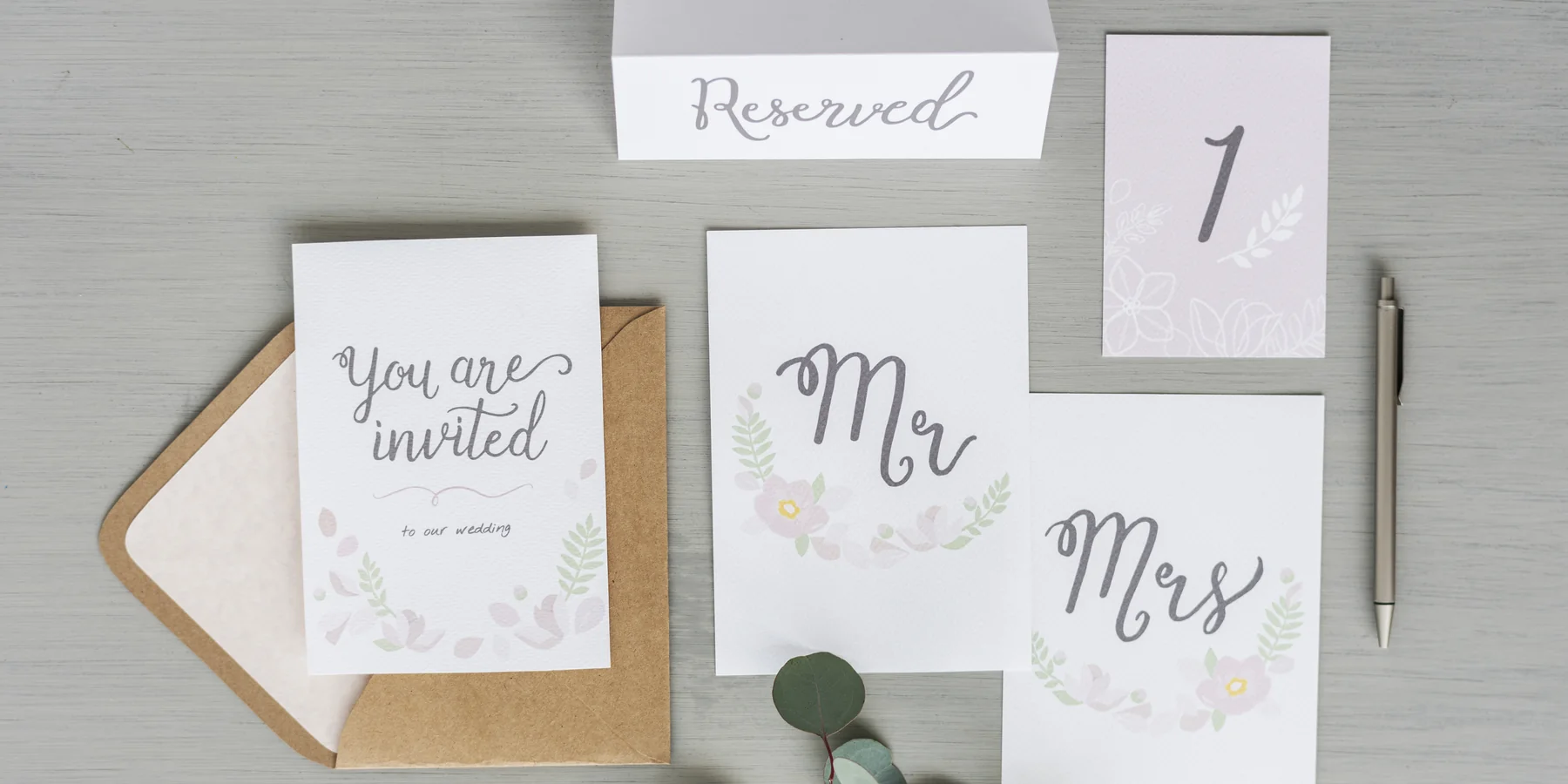
A wedding invitation has seven parts, in this order: who's hosting, the request, your names, the date and time, the place, what happens after the ceremony, and how to reply. On a formal card you spell out the date and time ("half after four o'clock"), and ask for "the honour of your presence" in a house of worship and "the pleasure of your company" anywhere else.
If you're hosting with your families' help and marrying somewhere other than a church, this is the whole thing (a slash marks a new line on the card):
Hotels, the dress code and the registry go on your website, not the card. The rest of this page has about 30 variations to copy: divorced, remarried, paying and late parents, two brides or two grooms, adults-only weddings and parties after an elopement. There's also a table of the rules the big etiquette guides can't agree on.
What goes on a wedding invitation, line by line
Formality changes the words, not the order. When you host yourselves, your names are the host line and the request ends "at their marriage".
| Line | Its job | Formal | Relaxed | The usual mistake |
|---|---|---|---|---|
| 1. Host | Says who's inviting | Mr. and Mrs. David Carter | Together with their families | One family's names, without asking the other |
| 2. Request | Sets the tone | request the honour of your presence | invite you to celebrate with them | "Honour" on the invitation, "honor" on the reply card |
| 3. Names | Who's marrying | Emma Louise / to / Mr. James Daniel Okafor | Emma and James | A middle name for one of you and not the other |
| 4. Date and time | When | Saturday, the twelfth of June / two thousand twenty-seven / at half after four o'clock | Saturday, June 12, 2027, at 4:30 p.m. | A weekday that doesn't match the date |
| 5. Place | Where the vows happen | Laurelhurst Chapel / Portland, Oregon | Juniper Hall, Portland | A full street address on a formal card |
| 6. Reception | What comes next | and afterward at the reception / Juniper Hall | Dinner and dancing to follow | "Reception to follow" when the party is somewhere else |
| 7. Reply | How and by when | R.s.v.p. in the lower left, or a reply card | Kindly reply by May 14 at [your website] | No reply-by date, or a web address that fails |
For the place, Emily Post's formal rules want the venue's name, then the city and the state written in full. WeddingWire adds the practical part: no ZIP code, and a street address only for a private home, since nobody can look one up by name.
On a traditional card, "R.s.v.p." stands alone in the lower left and means "reply to the return address on the envelope". If replies should go to an email address or a website instead, say where, and by when:
The reply card itself (meal choices, the "M" line, how many seats you've saved) has its own guide: wedding RSVP wording and deadlines. On the website address, the authorities split. Emily Post keeps it off the invitation, on the reply card or a small card of its own; Paperless Post and Vistaprint put a link at the bottom of the invitation, and Vistaprint adds a QR code. We'd give an engraved suite a separate card and print the address on anything less formal. On a BrideSpark website, guests look themselves up by name and open their own household's reply, so one web address is all the card needs.
Formal wedding invitation rules worth keeping
Most wording guides are paraphrasing the Emily Post Institute, so that's what we checked them against. Four of its rules do real work. The rest is taste.
Spell out the date, and leave "and" out of the year
Capitals for the day and the month, none for the year, and no "and". That's the American rule; British usage differs (see below). Ordinals are where typos hide: twelfth, ninth, eighth.
Write the time out in words
Emily Post wants "half after four o'clock", not "half past four" or "four-thirty", and calls "in the afternoon" unnecessary. We'd still add "in the morning" for a morning ceremony, because guests expect a wedding to start after lunch.
| Ceremony time | Formal | Relaxed |
|---|---|---|
| 11:00 a.m. | at eleven o'clock in the morning | at 11 a.m. |
| 12:00 p.m. | at twelve o'clock | at noon |
| 2:30 p.m. | at half after two o'clock | at 2:30 p.m. |
| 4:30 p.m. | at half after four o'clock | at 4:30 p.m. |
| 7:30 p.m. | at half after seven o'clock | at 7:30 p.m. |
Our rule of thumb: "half after" on an engraved card, "4:30" on anything with a photo on it.
Honour of your presence, or pleasure of your company
Traditionally the building decides. "The honour of your presence", spelled the British way even on an American card, is for a house of worship. "The pleasure of your company" covers everywhere else, hotel ballrooms and barns included. Greenvelope points out that neither line is required, and no guest is going to mark you down for the "wrong" one.
The awkward case is a religious ceremony outside a church. A WeddingWire forum poster asked exactly this, because her pastor was marrying them by a lake. The letter of the rule says "pleasure". If it's a church service in everything but the roof, "honour" is defensible, and most of the replies in that thread told her so. Either way, match the spelling on the reply card ("favour" or "favor").
Names and titles
Abbreviate Mr. and Mrs., but write "Doctor" in full unless the name then won't fit on one line. When the bride's parents host and she shares their surname, she's just "Emma Louise"; the groom gets his full name and a title, "Mr. James Daniel Okafor". And don't drop a woman's title. Emily Post notes that more women use "Doctor" socially than in the past, and its form for a couple who are both doctors is "Drs. Susan and David Carter". Older guides that tell brides and mothers to leave the title off are out of date.
When the etiquette guides disagree
We read the top-ranking guides side by side. Each states its rules as settled, yet they contradict each other, and some contradict themselves: Joy's guide says a formal card uses "half after", then prints "half past two" in its own formal sample. These are the splits you'll actually run into.
| The question | One side | The other side | What we'd do |
|---|---|---|---|
| "Half after" or "half past"? | "Half after four" (Emily Post) | "Half past four" (Zola, Paperlust, WeddingWire) | "Half after" on a traditional American card. The real mistake is using both in one suite |
| "And" in the year? | No: "two thousand twenty-seven" (Emily Post, Joy) | Yes: "two thousand and twenty-seven" (Paperlust; Zola's samples use both) | Follow your country. No "and" in the US; in Britain and Australia it's how the year is said |
| "In the afternoon"? | Not needed (Emily Post, Joy) | Include it, with afternoon ending at 5 p.m. (Zola); Paperlust's samples include it too | Leave it out, except "in the morning" for a morning ceremony |
| What "Reception to follow" means | The reception is at the same place (WeddingWire) | It's somewhere else; same place is "Reception immediately following" (Paperlust) | Same place: "Reception immediately following" reads right under both rules. Elsewhere: name it, "and afterward at Juniper Hall" |
| Street address on the card? | Venue and city only (WeddingWire, Joy, Paperlust) | Emily Post's own sample prints the reception's street address | Name and city on the invitation; street addresses on a details card and the website |
| A parent who has died | Not on the invitation, since only the living can host (Emily Post's sample for an only living parent leaves the other out) | Named under the couple's name: "daughter of ... and the late ..." (Greenvelope, Paperlust) | The line under the name. The host line stays correct and the parent is still on the card |
Who goes on the host line
Whoever issues the invitation goes at the top, which was simple when the bride's parents paid for everything. Now the money comes from several directions, and most of the WeddingWire threads we read on this come down to three situations.
You're paying for most of it, with help. "Together with their families" covers everyone without ranking anyone. If a father really wants to see his name printed, weigh one line of type against a family argument. We'd usually give him the line by naming both sets of parents as hosts (the "both families" example below).
One family paid and wants only their names. Let them host, and name the other parents in a line under their child's name. The full wording is under the groom's parents, below.
Divorced, remarried or blended families. Each hosting parent gets a line, shared with a new spouse if there is one. Once you're past four lines of parents, "Together with their families" reads better and leaves nobody ranked.
Show the draft to every parent before you order, including any who aren't named on it.
Wedding invitation wording examples to copy
Every example uses one placeholder wedding: Emma Louise Carter and James Daniel Okafor, Saturday, June 12, 2027, in Portland, Oregon. The first is complete. After that we mostly show the lines that change, and the date and place carry on as in the first. The layouts follow Emily Post's sample invitations wherever there is one.
You're hosting it yourselves
Formal, in a church or other house of worship:
Emily Post's passive opening, if inviting people in your own names feels stiff:
With your families and outside a church, use the version at the top of this page. The relaxed take:
The bride's parents are hosting
The groom's parents are hosting
Emily Post still names the bride first. If her parents should be on the card too, add one line under her name. This is the answer to "his parents paid and want only their names on it", and it mirrors Emily Post's own sample where the bride's parents host and the groom's appear in a "son of" line:
Both families are hosting
The bride's family goes first, and you both get full names without titles, as in Emily Post's sample:
Divorced or remarried parents
Divorced, neither remarried, hosting together. Each gets a separate line with no "and", since "and" means a married couple. The mother traditionally goes first, as "Ms." if she hasn't remarried. Emma's surname appears because her mother no longer shares it:
Both remarried, all four hosting. This is Emily Post's own pattern, with the mother and stepfather first:
Mother and stepfather hosting:
"Her daughter" is Emily Post's wording. If her stepfather raised her and everyone likes "their daughter" better, use that. And when the parents start to look like a law firm's letterhead:
A parent who has died
Strictly, only the living can host. Emily Post's sample for an only living parent simply leaves the other out:
To put the name on the card without breaking that rule, give it a line under your own, as Greenvelope and Paperlust suggest:
If the loss is recent and "the late" would be hard to see in print, there's a gentler version. In a WeddingWire thread on exactly this, one bride who had lost her mother used "Together with their parents", which includes everyone without spelling anything out:
The ceremony program has room for more than a line, and several replies in that same thread suggested remembering the parent there instead.
Two brides or two grooms
No rule says whose name goes first. Paperlust's tie-breaker is alphabetical by first name, and Greenvelope says alphabetical or whichever sounds best. The hosting family's child first is fair too. Then keep that order on everything else, down to the welcome sign.
Religious ceremonies
For a Roman Catholic wedding with a Nuptial Mass, Emily Post adds a line under the groom's name:
For a Jewish wedding, the only difference Emily Post notes is "and" instead of "to" between your names:
Customs vary a lot from one community to the next, so show the draft to your officiant before you order.
A civil ceremony
With a judge or a registrar marrying you, use "the pleasure of your company" and leave out phrases like "holy matrimony", which read oddly next to a civil ceremony.
Casual
Casual wording has one rule the formal guides skip: pick a voice and keep it. "Emma and James invite you" works, and so does "We'd love you to come". "Emma and James would love you to join us" doesn't. A Mumsnet poster asked about almost exactly that sentence, and the advice she got was not to switch from third person to first halfway through.
A private home is the one place where a full street address belongs on the invitation itself.
Adults only
The envelope does most of the work. In Emily Post's view the names on it define who's invited, so "Mr. and Mrs. Paul Bailey" doesn't include the Bailey children. Not every guest reads envelopes that closely, so say it again on the reply card or website. If it goes on the invitation, Greenvelope's advice is to keep the line out of the formal wording, down near the details, with no exclamation point. Debrett's, the British etiquette guide, suggests lines like these for the invitation or an information sheet:
If children are welcome at the ceremony but not the party, say exactly that. "Adult reception to follow" tells guests that only the reception is adults-only (Greenvelope), and Debrett's spells it out:
A reception-only or evening invitation
If nobody at this party will see you exchange vows, don't write "the marriage of" as if they will. A reply in a WeddingWire thread on reception-only parties made the same point: it sounds like the wedding happens at the event. "The recent marriage of" fixes it, and so does a reception "in honour of" the two of you:
For guests invited to the evening only, give the evening's start time and leave the ceremony off their card, so nobody turns up at 4:30 expecting the vows:
You eloped, and the party comes later
Inside Weddings gets this right: be upfront that you eloped, announce the marriage and invite people on the same card, keep the registry off it, and avoid the words "wedding" and "ceremony". We'd only bring "ceremony" back if you're repeating your vows in front of everyone, and then call it what it is, a vow renewal.
If you're marrying privately earlier the same day, with only family there:
Invitation wording in the UK, Ireland, Australia and New Zealand
Debrett's sets out a traditional British form that differs from the American one in small, visible ways. If your guests grew up with British conventions, this is the version that will look right to them:
What changes:
- "The pleasure of your company", even for a church wedding. Debrett's own sample uses it for a ceremony at St Paul's Church, Knightsbridge.
- No full stops (periods) after Mr and Mrs, as in Debrett's samples.
- The date in figures with an ordinal ("Saturday 12th June 2027") and the time as "3 o'clock". If you do write the year out, "two thousand and twenty-seven" is normal British English.
- The guest's name is handwritten in ink in the top left-hand corner.
- Invitations go out at least 12 weeks before the wedding, where the American advice is six to eight.
Debrett's adds that "there are no set rules and no 'right' or 'wrong' styles", a sentence worth keeping handy for any relative with strong opinions about fonts.
What not to put on a wedding invitation
Emily Post's list is short: no gifts, no registry, no attire. The one exception is "Black tie", which may go in the lower right corner of a reception invitation. Everything else guests need has a better home.
| Detail | Where it goes |
|---|---|
| Registry, cash fund, "no gifts, please" | Your website |
| Dress code beyond "Black tie" | Website FAQ, or a details card |
| Hotels, room-block codes, shuttles, parking | Details card and website |
| Welcome drinks, the farewell brunch | Website, or a separate card for the guests invited |
| Plus-ones and children | The envelope first, then the reply card and website |
| Meal choices | The reply card |
How to word the registry, the FAQ and the travel page is in what to put on a wedding website.
Proofreading and postage: the mistakes that cost money
A printer prints what you approve, and somebody's grandmother will check the card against her calendar. While researching this guide we found sample invitations on two of the top-ranking wording guides whose weekday didn't match the date. Work through this list on the final proof:
- Check the weekday on a calendar, not from memory or a template.
- Spell every name the way its owner does, with hyphens, accents and "Jr." where they belong. Give you both the same treatment: both middle names or neither.
- Read the ordinals letter by letter. Twelfth, ninth, eighth and twenty-first are the usual casualties.
- Use one spelling everywhere: "honour" or "honor", "favour" or "favor", on the invitation, the reply card and the website.
- Don't mix registers. A spelled-out year next to "4 p.m." "reads as an oversight on a traditional card", as Greenvelope puts it.
- Make the reply-by date match on the invitation, the reply card and the website.
- Type the web address into your phone exactly as printed, and scan the QR code with two different phones.
- Look for "and" between divorced parents, and for apostrophes in plural surnames ("the Carters", never "the Carter's").
- Have someone outside the wedding read it aloud. Then read it yourself from the bottom line up, so your brain can't fill in the gaps.
- Weigh one fully assembled invitation at the post office before you buy stamps, as Emily Post advises.
Skip that last one and it gets expensive, because shape matters as much as weight. At USPS retail prices (Notice 123, effective October 4, 2026, checked October 2026), a stamped letter costs $0.82 up to 1 oz and $1.11 up to 2 oz. Under DMM 101, a letter whose length divided by its height is under 1.3 or over 2.5, or that has clasps, strings, uneven thickness or too much stiffness, is "nonmachinable" and pays a $0.49 surcharge. A square envelope's ratio is 1.0, so a 1 oz square invitation costs $0.82 + $0.49 = $1.31: $131 for 100 instead of $82. A square suite that tips past 1 oz costs $1.60 each. Make the square bigger than 6 1/8 inches and it isn't a letter at all: USPS prices it as a large envelope, from $1.69. A 7 1/4 by 5 1/4 inch envelope (ratio 1.38) passes the shape test. Wax seals aren't named in the rules, but anything lumpy or tied with ribbon could count, so let the counter clerk decide before you buy a hundred stamps.
All of this assumes you have every address, which usually takes longer than the wording. See how to collect addresses for wedding invitations.
If you make your cards in BrideSpark, your names and date are filled in on each design from your wedding details (and the time and venue on the invitation), so a misspelled name fixed once is fixed on the invitation, the save-the-date and the menu. A line you retype by hand, like a spelled-out date, still needs your eyes. All 20 printable designs are free to download as print-ready PDFs in 24 styles, and printing is optional.
Frequently asked questions
Whose name goes first on a wedding invitation?
The bride's, by convention. Emily Post's samples keep her first even when the groom's parents host. Two brides or two grooms can use any order; alphabetical by first name is the usual tie-breaker. Use the same order on the invitation, the website and the program.
Is it "honour" or "honor" on a wedding invitation?
Traditional formal American invitations use the British spelling, "the honour of your presence". "Honor" isn't wrong. Pick one and use it on every piece, reply card and website included.
How do you write the year on a wedding invitation?
On a formal American invitation, spell it out in lowercase with no "and": "two thousand twenty-seven", as the Emily Post Institute advises. Debrett's traditional British form puts the date in figures instead ("Saturday 12th June 2027"), and where the year is written out in Britain, Ireland or Australia, "two thousand and twenty-seven" is normal. On a relaxed card, "2027" is fine as long as the time is in figures too.
Can I put our wedding website on the invitation?
Strict etiquette says no: Emily Post puts it on the reply card or a small separate card. Stationers such as Paperless Post and Vistaprint suggest a link at the bottom of the invitation, and Vistaprint suggests a QR code too. We'd do that on anything short of a formal engraved suite.
How do I include a parent who has died on the wedding invitation?
Put them in a line under your name, such as "daughter of Mrs. Susan Carter and the late Mr. David Carter", since traditional etiquette says only living parents can host. If "the late" feels too raw, "Together with their parents" includes everyone without spelling it out.
How do I say "adults only" on a wedding invitation?
Address the envelope only to the adults who are invited; the names on it define the invitation. Then say it kindly on the reply card or website: "We are sorry we are unable to invite children to our wedding, and hope that you will still be able to attend." On the invitation itself, keep any such line at the bottom, apart from the formal wording.
When should wedding invitations be sent?
Six to eight weeks before the wedding in the US (Emily Post), and at least 12 weeks in the UK (Debrett's). Destination weddings need more notice so guests can book travel; see how to plan a destination wedding. Save-the-dates go out months earlier, and our save-the-date wording guide has examples.
Plan it all in one place - free
Checklist, budget, guest list with online RSVPs, seating chart, timeline and your wedding website. Every feature, free for every couple.
Keep planning
All articlesPlanning guide
Bilingual Wedding Website and Invitations: Setup and Wording
Set up a bilingual wedding website and invitations: what needs both languages, which tools handle accents, and copy-ready Spanish, French and Italian wording.
Planning guide
How to Collect Addresses for Wedding Invitations (10 Messages)
How to collect addresses for wedding invitations: when to start, what to ask each household, 10 messages to copy, and rules for kids, APO and overseas guests.
Planning guide
Wedding Day Timeline: 5 Sample Schedules, Minute by Minute
Wedding day timeline samples where the minutes add up: 4 pm with and without a first look, 6 pm, a 1 pm Mass, a micro wedding, and real 2027 sunset times.